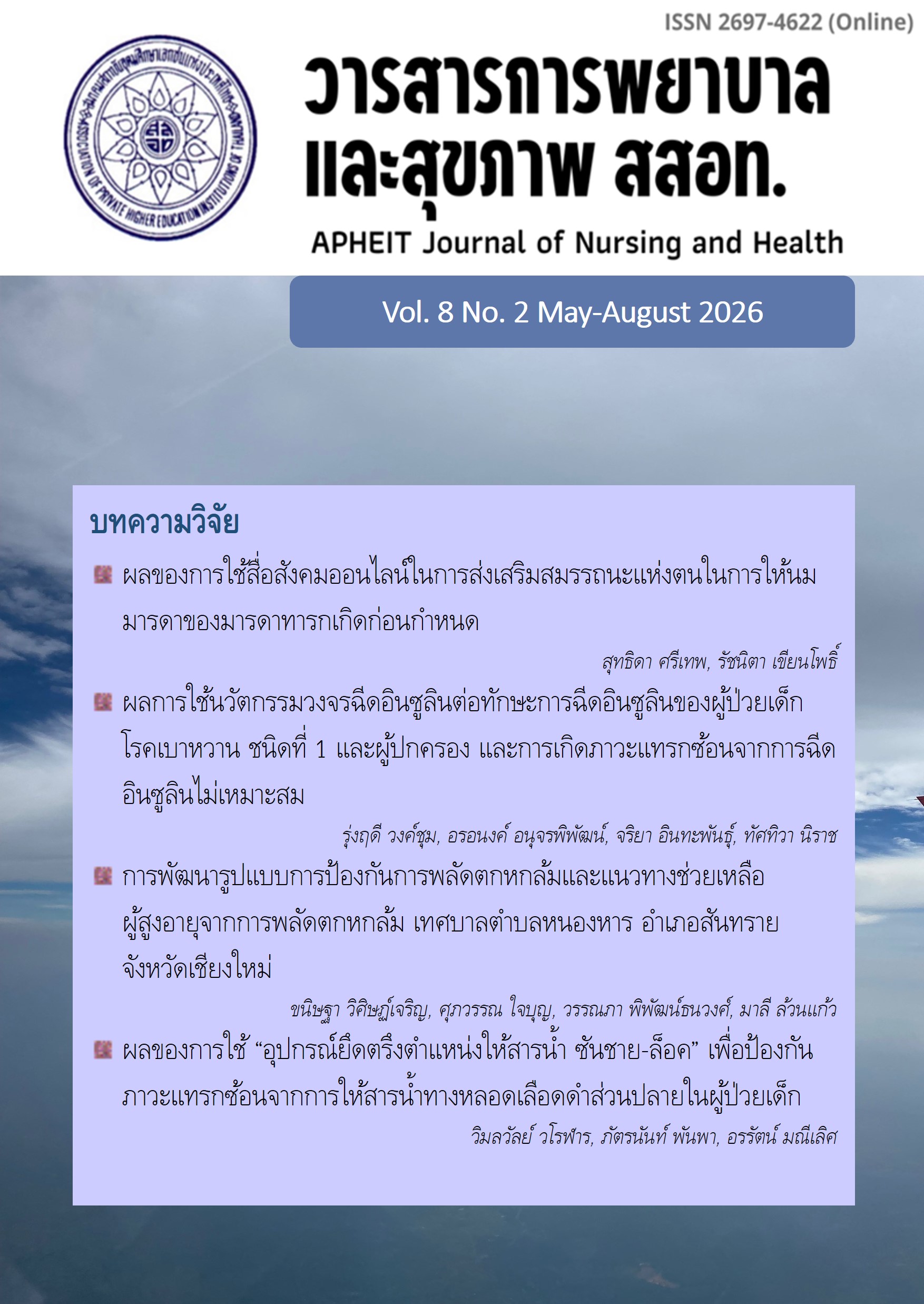
Effects of Using Social Media for Enhancing Breastfeeding Self-Efficacy among Mothers of Preterm Infants
Article Sidebar
Main Article Content
Abstract
This study employed a quasi-experimental two-group pretest–posttest design to examine the effects of social media use for enhancing breastfeeding self-efficacy among mothers of preterm infants. The participants consisted of 78 mothers of preterm infants admitted at Phrae hospital. The research instruments included a social media-based intervention designed to enhance maternal breastfeeding self-efficacy, a breastfeeding self-Efficacy questionnaire, and a breastfeeding practices questionnaire for mothor of preterm infant. Data were analyzed using percentage, mean, standard deviation, the Mann–Whitney U test, and the Wilcoxon signed ranks test.
The finding revealed that 89.7% of mothers in the intervention group, who received a social media-based support to enhance breastfeeding self-efficacy, continued breastfed their infants for 6 months, compared with 66.7% of mother in the usual care group. In addition, the mean breastfeeding self-efficacy scores of mothers in the intervention group was significantly higher than that of mothers in the usual care group following the intervention. Their post-intervention scores were also significantly higher than their pre-intervention score (Z = -5.211 and -5.119, respectively; p < .001).
These findings suggest that social media-based intervention to enhance breastfeeding self-efficacy can help mothers of premature infants sustain breastfeed for a longer duration and increases their confidence in continuing breastfeeding. This intervention may therefore benefit both mothers and their preterm infants.
Article Details
Section

This work is licensed under a Creative Commons Attribution-NonCommercial-NoDerivatives 4.0 International License.
เนื้อหาและข้อมูลในบทความที่ลงตีพิมพ์ในวารสารการพยาบาลและสุขภาพ สสอท. ถือเป็นข้อคิดเห็นและความรับผิดชอบของผู้เขียนบทความโดยตรง ซึ่งกองบรรณาธิการวารสารไม่จำเป็นต้องเห็นด้วย หรือร่วมรับผิดชอบใดๆ
บทความ ข้อมูล เนื้อหา รูปภาพ ฯลฯ ที่ได้รับการตีพิมพ์ในวารสารการพยาบาลและสุขภาพ สสอท. ถือเป็นลิขสิทธิ์ของวารสารการพยาบาลและสุขภาพ สสอท. หากบุคคลหรือหน่วยงานใดต้องการนำทั้งหมด หรือส่วนหนึ่งส่วนใดไปเผยแพร่ หรือเพื่อกระทำการใดๆ จะต้องได้รับอนุญาตเป็นลายลักษณ์อักษรจากวารสารการพยาบาลและสุขภาพ สสอท. ก่อนเท่านั้น
How to Cite
References
กระทรวงดิจิทัลเพื่อเศรษฐกิจและสังคม, สำนักงานพัฒนาธุรกรรมทางอิเล็กทรอนิกส์. (2565). รายงานผลการสำรวจพฤติกรรมผู้ใช้อินเทอร์เน็ตในประเทศไทย ปี 2565. สืบค้น 1 ตุลาคม 2569, จาก https://www.etda.or.th/getattachment/78750426-4a58-4c36-85d3-d1c11c3db1f3/IUB-65-Final.pdf.aspx
กิตติยาพร สังฆศรีสมบัติ, ชรินทร์พร มะชะรา, มนัสนันท์ พรมศรี, และนิรันดร ผานิจ. (2565). การพัฒนารูปแบบการให้ความรู้และให้คำปรึกษาผ่านแอปพลิเคชันไลน์ออฟฟิเชียลแอคเคานท์ สำหรับมารดาในการดูแลทารกเกิดก่อนกำหนด. วารสารศูนย์อนามัยที่ 9: วารสารส่งเสริมสุขภาพและอนามัยสิ่งแวดล้อม, 16(2), 623–641.
ขวัญฤดี ฮวดหุ่น. (2560). อิทธิพลของแอพพลิเคชั่นไลน์ในการสื่อสารยุคปัจจุบัน. วารสารศิลปการจัดการ, 1(2), 75-88.
ธัญลักษณ์ แก้วเนตร, อุมาวดี เหลาทอง, สุธรรม นันทมงคลชัย, และอาทิตย์ เพ็ชร์รักษ์. (2563). ผลของโปรแกรมส่งเสริมการเลี้ยงลูกด้วยนมแม่สำหรับแม่วัยรุ่นผ่านสื่อสังคมออนไลน์ คณะแพทยศาสตร์วชิรพยาบาล มหาวิทยาลัยนวมินทราธิราช. วารสารวิจัยการพยาบาลและสุขภาพ, 21(3), 54-68.
ผกามาส ตงศิริ, เจนจิรา แม้นประเสริฐ, และกรรณิกา หงษ์ศิริ. (2565). การกระตุ้นการดูดกลืนเพื่อส่งเสริมการดูดนมในทารกเกิดก่อนกำหนด: บทบาทพยาบาล. วารสารวิจัยสุขภาพและการพยาบาล, 38(3), 26-37.
พัชรพร แก้ววิมล. (2562). ผลของโปรแกรมการสร้างเสริมสมรรถนะการเลี้ยงลูกด้วยนมแม่กับการมีส่วนร่วมของครอบครัวต่อการเปลี่ยนแปลงน้ำหนักตัวของทารกคลอดก่อนกําหนดและความต่อเนื่องในการเลี้ยงลูกด้วยนมแม่. วารสารวิทยาศาสตร์และเทคโนโลยี, 27(6), 1106-1117.
รัตนาภรณ์ แปงทิศ, มินตรา อุทัยรังษี, วรรณ์วิการ์ ใจกล้า, และนิตยา ณะวัน. (2567). ผลของแอปพลิเคชันการเสริมสร้างสมรรถนะแห่งตนต่อการปฏิบัติการคงไว้ซึ่งนมมารดาและปริมาณน้ำนมของมารดาทารกแรกเกิดก่อนกำหนด. วารสารการพยาบาลและการศึกษา, 17(1), 71-84.
โรงพยาบาลแพร่, คลินิกนมแม่. (2566). สถิติการให้นมมารดาของทารกเกิดก่อนกำหนด ในปี 2564-2566 [เอกสารไม่ตีพิมพ์เผยแพร่].
ศุภมาส สุภารัตน์, นงลักษณ์ อินตา, และเนตรทอง นามพรม. (2560). ปัจจัยที่เกี่ยวข้องต่อการให้นมมารดาทารกเกิดก่อนกำหนดหลังจำหน่ายออกจากโรงพยาบาลมหาราชนครเชียงใหม่. พยาบาลสาร มหาวิทยาลัยเชียงใหม่, 44(2), 12-22.
สุทธิดา อ่อนละออ, พิมพาภรณ์ กลั่นกลิ่น, และมาลี เอื้ออำนวย. (2559). ปัจจัยทำนายการให้นมมารดาของมารดาทารกเกิดก่อนกำหนด. วารสารคณะพยาบาลศาสตร์ มหาวิทยาลัยบูรพา, 24(4), 32-42.
Brockway, M., Mcleod, S., Kurilova, J., Fenton, T. R., Duffett-Leger, L., & Benzies, K. M. (2023). Breastfeeding self-efficacy predicts breastmilk feeding in preterm infants at discharge from the neonatal intensive care unit. Nursing Open, 10(3), 1863-1870. doi:10.1002/nop2.1450
Choijorhor, R., Kantaruksa, K., Chotibang, J., & Chaloumsuk, N. (2023). “Striving for sufficient milk to have a healthy late preterm baby”: A grounded theory study. Pacific Rim International Journal Nursing Research, 27(2), 272-285. doi:10.60099/prijnr.2023.262036
Dennis, C-L. (1999). Theoretical underpinnings of breastfeeding confidence: A self-efficacy framework. Journal of Human Lactation, 15(3), 195-201. doi:10.1177/089033449901500303
Jansen, R. C., Nogueira, M. R. do N., Sousa, V. T. dos S., Oliveira, V. C., & Chaves, A. F. L. (2024). Breast feeding and infection control in premature newborns: An integrative review. Revista de Epidemiologia e Controle de Infecção, 14(1), 95-102. doi:10.17058/reci.v14i1.18400
Kronborg, H., Skaaning, D., & Brødsgaard, A. (2024). Breastfeeding self-efficacy, a predictor of early cessation of exclusive breastfeeding among mothers giving birth preterm. The Journal of Perinatal & Neonatal Nursing, 38(3), E18-E25. doi:10.1097/JPN.0000000000000699
Maleki, A., Faghihzadeh, E., & Youseflu, S. (2021). The Effect of educational intervention on improvement of breastfeeding self-efficacy: A systematic review and meta-analysis. Obstetrics and Gynecology International, 2021, 5522229. doi:10.1155/2021/5522229
Nakamura, K., Matsumoto, N., Nakamura, M., Takeuchi, A., Kageyama, M., & Yorifuji, T. (2020). Exclusively breastfeeding modifies the adverse association of late preterm birth and gastrointestinal infection: A nationwide birth cohort study. Breastfeeding Medicine, 15(8), 509-515. doi:10.1089/bfm.2020.0064
Nayebinia, A. S., Faroughi, F., Asadi, G., & Fathnezhad-Kazemi, A. (2024). Factors affecting breastfeeding self-efficacy among mothers with preterm infants. Women’s Health (London, England), 20, 17455057241305297. doi:10.1177/17455057241305297
Spannhake, M., Jansen, C., Görig, T., & Diehl, K. (2022). Well-Informed and willing, but breastfeeding does not work: A qualitative study on perceived support from health professionals among German mothers with breastfeeding problems. Healthcare, 10(6), 1009. doi:10.3390/healthcare10061009
Wheeler, B. J., & Dennis, C. (2013). Psychometric testing of modified breastfeeding self-efficacy scale (short form) among mothers of ill or preterm infants. Journal of Obstetric, Gynecologic, & Neonatal Nursing, 42(1), 70-80. doi:10.1111/j.1552-6909.2012.01431.x
World Health Organization [WHO]. (2025). Breastfeeding. Retrieved September 20, 2025, from https://www.who.int/health-topics/breastfeeding#tab=tab_1
Zhang, R., Ying, E., Wu, X., Qin, H., Guo, Y., Guo, X., … Chen, J. (2024). A systematic review and meta-analysis of breastfeeding and neurodevelopmental outcomes in preterm infant. Frontiers in public health, 12, 1401250. doi:10.3389/fpubh.2024.1401250