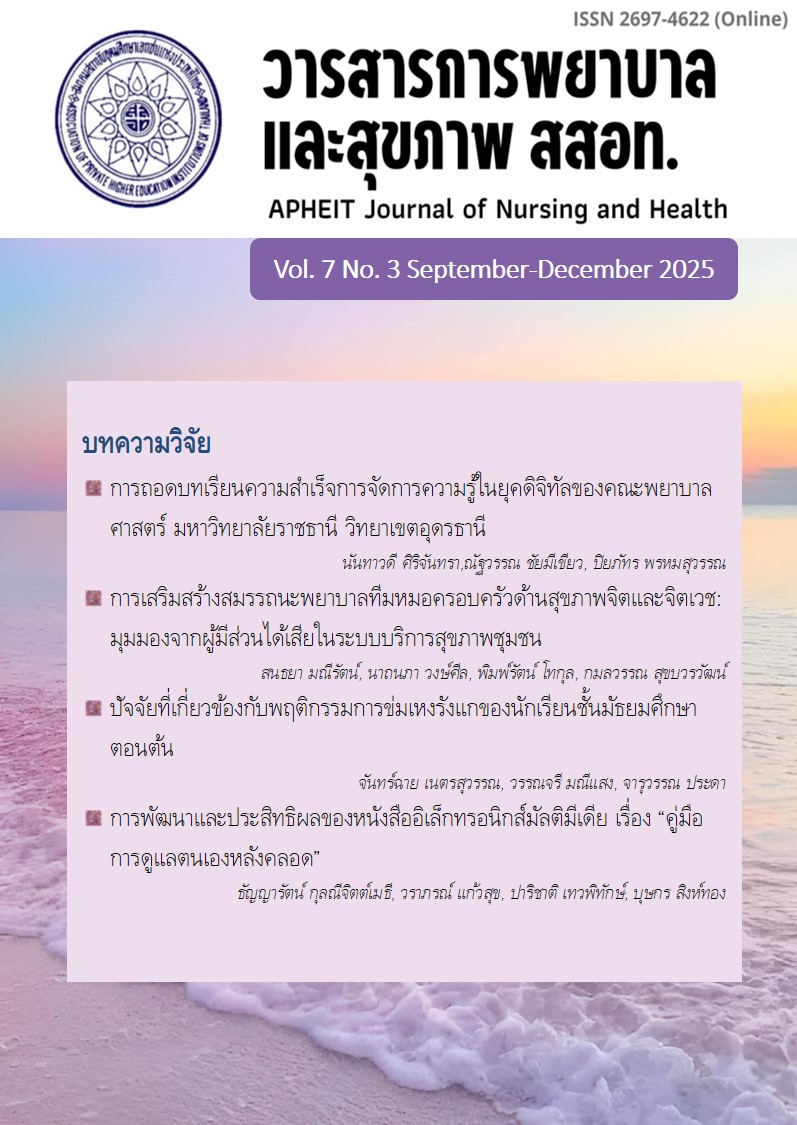
Strengthening Mental Health Nursing Competencies in Family Care Teams Insights from Community Health Stakeholders
Article Sidebar
Main Article Content
Abstract
This qualitative study aimed to explore the current situation, barriers, challenges, and mental health and psychiatric service system within primary health care, as well as to examine stakeholders' perspectives on the necessity for and approaches to developing mental health and psychiatric competencies among Family Care Team Nurses (FCTNs) at the sub-district level. Seventy key stakeholders from the primary health care system participated. Data were collected through in-depth interviews with 40 participants using a semi-structured interview guide and focus group discussions with 30 participants guided by a focus group discussion guide. Data were analyzed using content analysis. The findings related to the situation, barriers, challenges, and the mental health and psychiatric service system revealed three major themes: 1) the complexity of mental health conditions and limitations of mental health and psychiatric services at the primary care level; 2) role expansion beyond primary care nursing and the vulnerability of nurses’ roles within the community mental health and psychiatric system; and 3) structural constraints and drivers influencing mental health and psychiatric service delivery by primary care nurses. In addition, stakeholders’ perspectives on the necessity for and approaches to developing mental health and psychiatric competencies among sub-district FCTNs reflected the PRIMARY model, which encompasses seven domains of desirable nursing competencies.
The findings provide essential baseline evidence for the development of competency assessment tools and competency-based curriculum guidelines to enhance primary care nurses’ capabilities, thereby improving the quality of care for individuals with mental health and psychiatric conditions in community settings.
Article Details

This work is licensed under a Creative Commons Attribution-NonCommercial-NoDerivatives 4.0 International License.
เนื้อหาและข้อมูลในบทความที่ลงตีพิมพ์ในวารสารการพยาบาลและสุขภาพ สสอท. ถือเป็นข้อคิดเห็นและความรับผิดชอบของผู้เขียนบทความโดยตรง ซึ่งกองบรรณาธิการวารสารไม่จำเป็นต้องเห็นด้วย หรือร่วมรับผิดชอบใดๆ
บทความ ข้อมูล เนื้อหา รูปภาพ ฯลฯ ที่ได้รับการตีพิมพ์ในวารสารการพยาบาลและสุขภาพ สสอท. ถือเป็นลิขสิทธิ์ของวารสารการพยาบาลและสุขภาพ สสอท. หากบุคคลหรือหน่วยงานใดต้องการนำทั้งหมด หรือส่วนหนึ่งส่วนใดไปเผยแพร่ หรือเพื่อกระทำการใดๆ จะต้องได้รับอนุญาตเป็นลายลักษณ์อักษรจากวารสารการพยาบาลและสุขภาพ สสอท. ก่อนเท่านั้น
References
ณัฐติกา ชูรัตน์, มุสลินท์ โตะแปเราะ, และนิรุสณีย์ อากาจิ. (2565). สมรรถนะพยาบาลผู้ปฏิบัติงานจิตเวชชุมชนจังหวัดนราธิวาสในการป้องกันการกลับเป็นซ้ำของผู้ป่วยจิตเภทแนววิถีพหุวัฒนธรรม: TRUCKS model. วารสารมหาวิทยาลัยนราธิวาสราชนครินทร์, 14(2). 177-192.
วิวรรธน์ วงศ์ตาขี่. (2560). การพัฒนาสมรรถนะทีมพยาบาลในการดูแลผู้ป่วยจิตเภทที่มีพฤติกรรมรุนแรง โรงพยาบาลวังยาง จังหวัดนครพนม. วารสารโรงพยาบาลนครพนม, 4(2), 50-68.
ศรินรัตน์ จันทพิมพ์, และขนิษฐา นันทบุตร. (2561). การดูแลผู้ป่วยจิตเภทโดยชุมชน. วารสารการพยาบาลและการดูแลสุขภาพ, 36(2), 68–76.
สำนักงานหลักประกันสุขภาพแห่งชาติ (สปสช.) และกรมสุขภาพจิต กระทรวงสาธารณสุข. (2559). คู่มือการดูแลผู้ป่วยจิตเวชเรื้อรังกลุ่มเสี่ยงในชุมชนสำหรับบุคลากรของหน่วยบริการระดับปฐมภูมิ. สืบค้น 1 ธันวาคม 2568, จาก https://dmh-elibrary.org/items/show/274
สำนักงานสภาพัฒนาการเศรษฐกิจและสังคมแห่งชาติ. (2568). รายงานการวิเคราะห์สถานการณ์ความยากจนและความเหลื่อมล้ำในประเทศไทย ปี 2567. สืบค้น 4 ธันวาคม 2568, จาก https://www.nesdc.go.th/wordpress/wp-content/uploads/2025/09/Final-Report-2024_as-of-20250912.pdf
สำนักบริหารการสาธารณสุข สำนักงานปลัด กระทรวงสาธารณสุข. (2557). ทีมหมอครอบครัว (Family Care Team). กรุงเทพ มหานคร: โรงพิมพ์ชุมนุมสหกรณ์การ เกษตรแห่งประเทศไทย จำกัด.
Aguilar-Ferrándiz, M. E., Toledano-Moreno, S., Casas-Barragan, A., Albornoz-Cabello, M., Tapia-Haro, R. M., & Correa-Rodriguez, M. (2024). Implementation of a coaching training for enhancing empathy and emotional intelligence skills in health sciences students: A prospective study. BMC Medical Education, 24(1): 76. doi: 10.1186/s12909-024-05076-z
Bazemore, A. W., Petterson, S. M., & McCulloch, K. K. (2024). US primary care workforce growth: A decade of limited progress, and projected needs through 2040. Journal of General Internal Medicine, 40(2), 339–346. doi:10.1007/s11606-024-09121-x
Khatatbeh, H., Pakai, A., Al-Dwaikat, T., Onchonga, D., Amer, F., Premusz, V, & Olah, A. (2022). Nurses’ burnout and quality of life: A systematic review and critical analysis of measures used. Nursing Open, 9(3), 1564–1574. doi: 10.1002/nop2.936
Lundqvist, L-O., Rytterström, P., Rask, M., Brunt, D., Sellin, T., Grim, K., … Schröder, A. (2024). Influence of mental health service provision on the perceived quality of life among psychiatric outpatients: Associations and mediating factors. Frontiers in Psychiatry, 14, 1282466. doi: 10.3389/fpsyt.2023.1282466
Martins, A. K. L., & Vieira, N. F. C. (2014). Nurses’ mental health competencies in the primary care: A methodological study. Online Brazilian Journal of Nursing, 13(suppl I), 373-375.
McInnes, S., Halcomb, E., Ashley, C., Kean, A., Moxham, L., & Patterson, C. (2022). An integrative review of primary health care nurses’ mental health knowledge gaps and learning needs. Collegian, 29(4), 540–548. doi: 10.1016/j.colegn.2021.12.005
National Academies of Sciences, Engineering, and Medicine [NASEM]. (2025). Building a workforce to develop and sustain interprofessional primary care teams. Washington, DC: National Academies Press.
Roncero, C., García-Ullán, L., de la lglesia-Larrad, J. I., Martín, C., Andrés, P., Ojeda, A., … Montejo, Á. L. (2020). The response of the mental health network of the Salamanca area to the COVID-19 pandemic: The role of telemedicine. Psychiatry Research, 291, 113252. doi: 10.1016/j.psychres.2020.113252
Sumriddetchkajorn, K., Shimazaki, K., Ono, T., Kusaba, T., Sato, K., & Kobayashi, N. (2019). Universal health coverage and primary care, Thailand. Bulletin of the World Health Organization, 97(6), 415–422. doi: 10.2471/BLT.18.223693
Wijnën-Meijer, M., Brandhuber, T, Schneider, A, & Berberat, P. O. (2022). Implementing Kolb’s experiential learning cycle by linking real experience, case-based discussion and simulation. Journal of medical education and curricular development, 9. doi: 10.1177/23821205221091511
Winqvist, I., Näppä, U., & Häggström, M. (2023). Quality of care during rural care transitions: A qualitative study on structural conditions. BMC Nursing, 22, 262. doi: 10.1186/s12912-023-01423-5
World Health Organization [WHO]. (2016). mhGAP intervention guide for mental, neurological and substance use disorders in non-specialized health settings (Version 2.0). Retrieved December 3, 2025, from https://www.who.int/publications/i/item/9789241549790
World Health Organization [WHO]. (2020). Mental health: Strengthening our response. Retrieved December 6, 2025, from https://cdn.ymaws.com/www.safestates.org/resource/resmgr/connections_lab/glossary_citation/mental_health_strengthening_.pdf
World Health Organization [WHO]. (2022). World mental health report: Transforming mental health for all. Retrieved December 28, 2025, from https://www.who.int/publications/i/item/9789240049338
World Health Organization Regional Office for the Western Pacific & Asia Pacific Observatory on Health System and Policies. (2024). Thailand health system review. Health Systems in Transition, 13(1), 9789290620457.