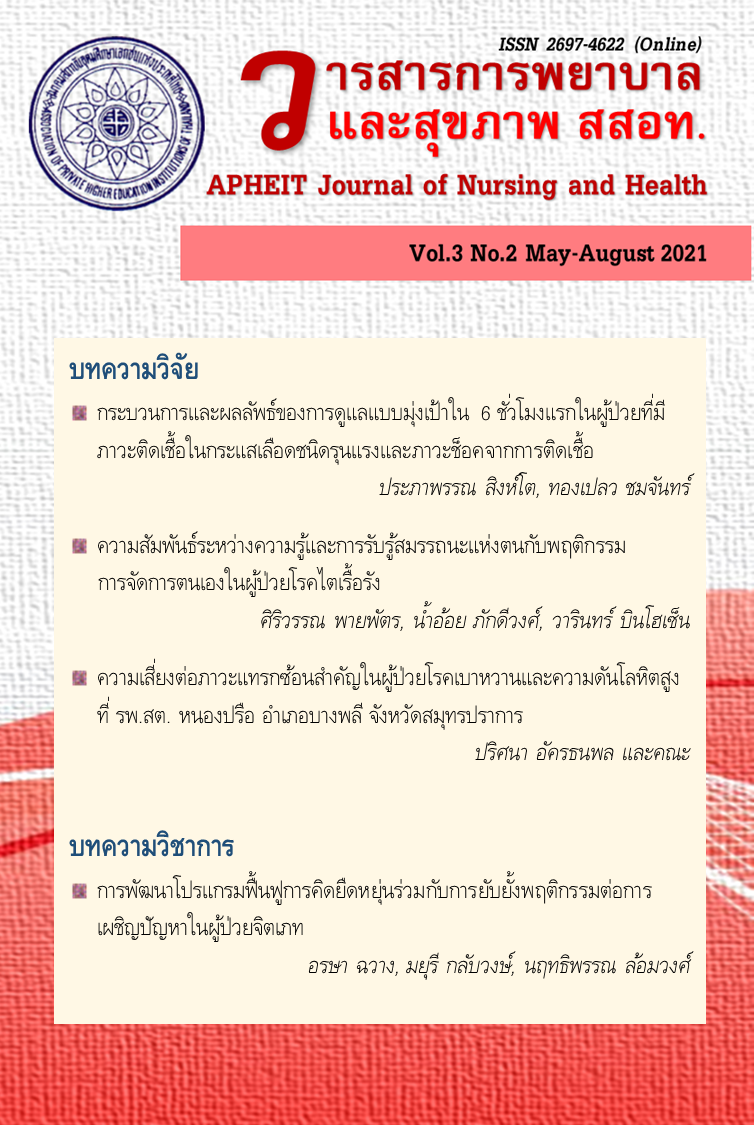
The Association among Knowledge, Self-Efficacy and Self-Management Behaviors in Patients with Chronic Kidney Disease
Article Sidebar
Main Article Content
Abstract
This study aimed to investigate self-management behaviors and predictive power of self-management of persons with chronic kidney diseases by knowledge and self-efficacy. Curtin self-management theory was used as conceptual framework. Ninety one persons with chronic kidney diseases were purposively selected. Data were collected by questionnaires concerning demographic data, knowledge, self-efficacy and self-management behaviors. Content validity was approved with content validity index ranging from 0.86-0.97. KR20 of knowledge questionnaire and Cronbach’s coefficient alpha of self-efficacy and self-management behaviors questionnaires were 0.72, 0.96 and 0.96 respectively. Data were analyzed using descriptive statistics, Pearson’s Product Moment Correlation, and Stepwise Multiple regression. The findings showed that 70.33% of the sample had overall self-management behavior scores at a low level. Regarding the subscale, 56.04% had moderate level of self-care activity, 84.62% and 97.80% had low levels of communication with healthcare providers and self-advocacy behaviors, respectively. Knowledge and self-efficacy were significantly positive correlation with self-management behaviors and could predict 51.00%.
Article Details
Section
เนื้อหาและข้อมูลในบทความที่ลงตีพิมพ์ในวารสารการพยาบาลและสุขภาพ สสอท. ถือเป็นข้อคิดเห็นและความรับผิดชอบของผู้เขียนบทความโดยตรง ซึ่งกองบรรณาธิการวารสารไม่จำเป็นต้องเห็นด้วย หรือร่วมรับผิดชอบใดๆ
บทความ ข้อมูล เนื้อหา รูปภาพ ฯลฯ ที่ได้รับการตีพิมพ์ในวารสารการพยาบาลและสุขภาพ สสอท. ถือเป็นลิขสิทธิ์ของวารสารการพยาบาลและสุขภาพ สสอท. หากบุคคลหรือหน่วยงานใดต้องการนำทั้งหมด หรือส่วนหนึ่งส่วนใดไปเผยแพร่ หรือเพื่อกระทำการใดๆ จะต้องได้รับอนุญาตเป็นลายลักษณ์อักษรจากวารสารการพยาบาลและสุขภาพ สสอท. ก่อนเท่านั้น